
1. What is bonding strength?
Bond strength refers to the stress required to cause damage to the interface between the adhesive and the adherend or its adjacent area in the bonded part under external force. Bond strength is also known as adhesive bonding strength.
Adhesive strength refers to the stress required for the adhesive system to fail, and its magnitude depends not only on the adhesive force, mechanical properties of the adhesive, properties of the adherend, and bonding process, but also on the joint form, stress conditions (type, magnitude, direction, frequency), environmental factors (temperature, humidity, pressure, medium), testing conditions, experimental techniques, and so on.
The bonding strength of adhesives is one of the important indicators for evaluating the quality of adhesives. Based on the stress conditions during adhesive application, bonding strength is generally classified into shear strength, tensile strength, peel strength, impact strength, etc.
II. Stress form of bonded joints
The forces exerted on the adhesive layer of a bonded joint under external forces can be summarized into four forms: shear, tension, uneven peeling, and delamination.
A. Cutting.
The external forces are equal in magnitude and opposite in direction, essentially parallel to the bonding surface, and evenly distributed across the entire bonding surface.
B. Stretching.
Also known as uniform peeling, it occurs under the action of oppositely directed tensile forces, perpendicular to the bonding surface, and is uniformly distributed across the entire bonding surface.
C. Uneven detachment.
Also known as cleavage, the direction of external force is also perpendicular to the bonding surface, but its distribution is uneven.
D. Stripping.
The direction of external forces forms a certain angle with the bonding surface, and they are primarily distributed along a straight line on the bonding surface. In the same adhesive system, it is quite possible for several of the aforementioned four forces to coexist, with the question being which one predominates.
III. Classification of bonding strength
Based on the different stress conditions of adhesive joints, adhesive strength can be specifically classified into shear strength, tensile strength, non-uniform peel strength, and peel strength, among others.
1. Shear strength
Shear strength refers to the shear force that can be withstood by a unit of adhesive surface when the adhesive part is damaged, and its unit is expressed in megapascal (MPa). Shear strength is further divided into tensile shear, compressive shear, torsional shear, and bending shear strength according to the force mode during testing.
Adhesives with different properties exhibit varying shear strengths. Generally, tough adhesives exhibit higher shear strengths than flexible adhesives. Numerous tests have shown that thinner adhesive layers yield higher shear strengths.
The most significant factors affecting the test conditions are environmental temperature and test speed. As the temperature increases, the shear strength decreases, and as the test speed slows down, the shear strength also decreases. This indicates that temperature and speed have an equivalent relationship, meaning that increasing the test temperature is equivalent to reducing the loading speed.
2. Tensile strength
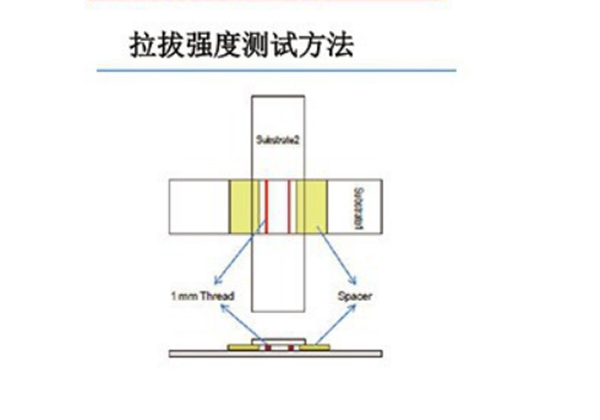
Tensile strength, also known as uniform peel strength or direct tensile strength, refers to the tensile force per unit area when the adhesive is subjected to force and breaks. The unit is expressed in megapascal (MPa). Because the tensile force is much more uniform than the shear force, the tensile strength of most adhesives is much higher than their shear strength. In practical measurements, under external forces, the specimen may undergo both shear and transverse compression due to the greater deformation of the adhesive compared to the adherend, as well as the non-axial nature of the external forces. Therefore, simultaneous fracture may occur during peeling. If the length of the specimen can be increased and the bonding area can be reduced, the impact of peeling during fracture can be reduced, making the stress distribution more uniform. The effects of elastic modulus, adhesive layer thickness, test temperature, and loading speed on tensile strength are basically similar to those on shear strength.
3. Uneven peel strength
The uneven peel strength represents the maximum load that a bonded joint can withstand when subjected to an uneven peeling force. Since the load is mostly concentrated on the two edges or one edge of the adhesive layer, it is a force per unit length rather than per unit area, with the unit being kN/m².
4. Peel strength
Peel strength refers to the maximum load per unit width that can be withstood when separating bonded parts under specified peeling conditions, and its unit is expressed in kN/m. There are various forms of peeling, which can generally be divided into L-type peeling, U-type peeling, T-type peeling, and curved surface peeling.
As the peel angle changes, the peeling pattern also varies. When the peel angle is less than or equal to 90°, it is L-shaped peeling, and when it is greater than 90° or equal to 180°, it is U-shaped peeling. These two patterns are suitable for peeling in the bonding of rigid materials and flexible materials. T-shaped peeling is used for peeling in the bonding of two flexible materials. The peel strength is affected by factors such as the width and thickness of the test piece, the thickness of the adhesive layer, the peel strength, and the peel angle.
The PUR hot melt adhesive, acrylic AB glue, UV glue, etc. produced by Shenzhen Meike Yi New Material Co., Ltd. have strong bonding strength. Our application laboratory can test the shear strength, tensile strength, etc. of the bonded materials to meet customer needs. We welcome customers to visit our company for guidance.